WRECKS THAT BUG YA'


Anyone who has done a lot of shipwreck research knows that there are just some wrecks that, as my late dad used to say, “Stick in yer’ craw.” Frankly I prefer to say that they haunt you. Indeed I have several- they are the wrecks that you simply cannot find enough information on or what information there is happens to be conflicting in one way of another. This little tale is about a little enigma by the name of GARDEN CITY.
Click HERE to see the book

I first came across the GARDEN CITY while writing the story of her fleet mate and near sister OSWEGATCHIE. The GARDEN CITY stuck with me, although I had enough information to write a whole chapter about the OSWEGATCHIE in one of my early and now out of print books. (I resurrected it my book “The Best of Wes”, I despise that title, by the way… it was the publisher’s idea and they refused to change it. But it has some of my favorite work in it and it still sells, so my wife won’t let me complain… around her anyway.)


GARDEN CITY was a former passenger and roll-on cargo vessel on Lake Ontario that found herself, like her sister, hedged into obsolescence by the expanding railroads and the coming of larger vessels. Built in 1873 for the Northern Transit Company she was one a fleet of just over a dozen nearly identical 135 foot long steam propellers. They were deliberately constructed to fit the locks of the old Welland Canal. 
Early photo of the GARDEN CITY.
Note the passengers on the bow.
In the 1870s a steamship trip was a big deal.

Just a few years after her construction, however the N.T. line fell on rude financial times. On December 29, 1875 it was announced that the entire fleet would be sold at an Assignee’s sale. That sale for the GARDEN CITY and her fleet mates MAINE and CHAMPLAIN took place where they were last laid up, Toledo, Ohio on January 6, 1876. By 1879 the GARDEN CITY was owned by Frank Gilchrist. His objective was simple; cash in on Michigan’s booming lumber industry. With that in mind the boat was taken to Alpena and cut down to a lumber hooker. Here mid cabins were removed and her sides cut lower to facilitate the hand-loading and unloading of the lumber shovers. She went promptly into hauling board feet of fresh timber.


Seen here at the Soo, the GARDEN CITY is heavily loaded
with a bulk cargo of some sort. Boland used her for iron ore
and for coal as well as lumber. 


GARDEN CITY went about her business until in the spring of 1897. She was moored for the night at Alpena, Michigan when the trouble began. Everyone aboard was asleep at 3am as a fire broke out between her smoke stack and its surrounding timbers. The fire was extinguished, but not before it consumed her aft quarters and engine room. The boat’s machinery was saved, but her aft section had to be completely rebuilt at a cost of $3,000. She was uninsured and thus ended up being sold in 1898 to John J. Boland.

On Friday evening, October 10, 1902 she had just finished unloading a lumber cargo at Bay City, Michigan and was heading to Saginaw for winter lay-up. She again caught fire and this time she burned to the water’s edge.

And that folks… is where the information ends.

You cannot find a mention of her in any of the local news papers. Of course it doesn’t help that the Bay City Times apparently had no one doing “Marine Matters” in that time. To make the matter worse she burned late on a Friday and in that era of hand-set type newspapers most of Saturday’s paper was already composed and laid out by late Friday evening and pretty much all of the Sunday papers were fluff pieces done in advance, so the paper’s staff could have the weekend off. So the story of a burned lumber hooker in the river minus any fatalities was easily overlooked. What news items are in the marine columns of other papers of the era are either exceptionally brief or have some conflicting details. Some reports that have been passed along to us as history say she burned, “…on Saginaw Bay, three miles south of Bay City.” Which is really hard to do since Saginaw Bay is located four miles north of Bay City. Odds are that published error began with an October 15, 1906 Detroit Free Press drama article about the bad luck of the N-T fleet. Most more reliable articles say that she burned south of Bay City, but the distances are stated either as three miles or four miles south.

This wreck quietly nagged at me for quite a while. Of course what often happens is the answer pops up when you’re not looking for what you once were really looking for. In the case of the GARDEN CITY I was looking for a totally different wreck along the Saginaw River and had gotten a CD or aerial photos from the US Geological Survey. The set that I requested was from October 29, 1965 and runs the entire length of the river. 


Frame from a U.S. Geological Survey run.
The original .TIFF is a far higher resolution than Blogger
will allow me to display in this post.

These photos come in a .TIFF format and are high resolution. While examining one of the frames, just at the southern tip of Bay City’s “Middle Grounds” I spotted a well defined outline of a vessel! The water, although highly murky, was apparently quite low at the time of the photos. An earlier 1954 USGS image of the same area does not show her at all, yet a partially sunken scow barge nearby is clearly visible.


Here is the interesting portion of the USGS frame.

And right here is what caught my eye.


Using Google Earth I measured the location to be about 3.6 miles south of the city limits as they would have been in 1902.
The arrow shows the distinct outline of a sunken vessel. Note: Just to the left
of the sunken vessel is a sunken work scow that shows up as a tark rectangle.


But, was this the GARDEN CITY or was it one of the two tugs that had sunk in the same general area? How do you measure its length from a USGS photo? There is no real exacting scale on the image. But there is one certain landmark in the image that can be measured.
In the lower left we see the end of Runway 5 at James Clements Airport.
It made for a handy yardstick.


In the lower left of the image is James Clements Airport. Runway 5 on that airfield is exactly 75 feet wide. Zooming in on it I imposed a digital arrow across the runway. That gave me a 75 foot long measuring stick. By transposing that onto the wreck in the same image I was able to estimate it’s length at between 130 and 140 feet. The length of the GARDEN CITY was 135 feet.


Here the ~75 foot measuring arrow is superimposed on the wreck...

... the remaining distance, shown by the dotted line is about 55 feet.
That would make the length of the wreck in the neighborhood of 135 feet.


Of course, just one measurement isn’t good enough… at least not for me. So I did a bit more searching. On Google Earth’s 2014 view of the same area you can just barely make out the wreck. 


This image shows us the 2014 remains. Note the beams and the dot where the keel
should be. This may very well be her rudder post as they often remain standing.

One side of the outline can be seen and, most importantly, a small portion of her keel can also be made out. Using Google Earth’s measuring stick, which I know is not hugely precise, I set two lines, one for the keel segment and one for the beam segment and measured between them. The distance, which would equate to ½ of her overall beam was approximately 12 feet. The overall beam of the GARDEN CITY is listed as 26 feet.


This is a stand back and squint image, but looking carefully, you can see the wreck's
beams and a small bit of her keel. Measuring from the keel to the beam gave a
distance of about 12 feet. Thus the vessel in question would have been  about double that in beam.
The Google Earth longitude and latitude are also included so you go and see for yourself. 


Now, none of us can ever be 100% sure and put a name onto a river wreck like this without a definitive photo showing her name or a name board itself. That said, the other tugs lost in this area are the KATY REID, which was identified by me as being well inside the north channel of the Middle Grounds and the L.G. MASON. Which is listed as only being only 122 feet in length. Thus both are disqualified.

In my opinion, this is the GARDEN CITY.


And now it's time for shameless self promotion...
If you like my writing, try my books! Those that are
still in print can be gotten HERE directly from me.
In fact I'll autograph and personalize them for you,
or for whoever you wish. My prices are the same
as my publisher, or Amazon- but you'll be
dealing directly with me, the author!


PAINT WITH A HISTORY


Way back on December 16, 1985 the Huron Cement carrier S.T. CRAPO was the last boat of the season to come up the Saginaw River and as luck would have it, I had just gotten back home from college in Florida the day before. I got down to the dock at Carrollton’s sixth street that evening and was welcomed aboard by her first mate Don Ghiata who was supervising the unloading. Normally he served as a captain of Huron’s boats, but the slowdown in cement powder demand had him working as a first mate as the 1985 season ended. Thus, my Christmas break got off to a good start with a tour of the CRAPO.
 
The steamer S.T. CRAPO on a snowy evening at the
Huron Cement Company's 6th street dock, Carrollton, MI.
December 16, 1985.
Along the way Captain Ghiata and I talked about everything from trimming the cement load to layering your clothing to stay warm while out on the deck. As we moved around the boat, he noticed that I was taking a lot of photos from off angles and close-ups of quite ordinary things. When he asked about that I said that the pictures were for modeling and I was considering doing a model of the CRAPO. I told him how many boats I had in my current fleet that building model boats from scratch was a healthy distraction from flying. Captain Ghiata asked if I ever sold any? I told him that I was a student working my way through college and I’d sell anything except my bicycle. He said he’d like me to build him a model. When I said I would be happy to do that for him, he ordered the JOHN W. BOARDMAN. That was great for me because the previous summer I’d been in a Bay City antique mall and had bought a 50 year anniversary book, “The Huron Heritage 1907-1957” and it had a couple of great photos of the BOARDMAN for me to work from. He offered to buy that too… I declined. My list of not for sale stuff now included my bicycle and that book.
My copy of the Huron Cement 50th anniversary book.
I saw this same book for sale on the internet today,
the asking price was $49.95... the price written
inside my copy is $12. 

It was a happy trip for the crew of the CRAPO because their season was coming to an end. The only question was if the Saginaw River was going to freeze them in. The ice was about five inches thick that evening and there was no sign of a thaw coming until spring.

The galley crew happily peeling potatoes...
they know it's the end of the season. 

One of the CRAPO's engineers having a late evening snack.
If anyone recognizes this fellow, please let me know so I can
put his name in with the picture. My notes from that night are gone.


At the time of my visit in December of 1985 the CRAPO was still a hand-fired coal burner and was known for her occasional bursts of heavy black smoke. One summer morning as she was coming through the Zilwaukee Bridge she let go with a belch of black smoke and as she passed a group of us boatnerds the mate came out of the pilothouse and shouted “Sorry about the smoke!” Someone shouted back, “We want more black smoke for the cameras!” Eventually in the winter of 1994-1995 she converted to an oil burner.
The CRAPO's steering gear.

Through her entire career the CRAPO was powered by a triple expansion three cylinder steam engine that produced 1,800 indicated horsepower. Steam was provided three Scotch boilers.
 
A peek into her engine quarters.


Unloading the cement powder that night the CRAPO used a system that was her original design. It used four tunnel conveyors with no air-slides and was unloading about to 500 tons of cement powder during that single hour that I was aboard her. She had a maximum carrying capacity of 8,899 tons at her mid-summer draft which was carried in six holds.

Looking down the CRAPO's tunnel.

At the bow- her windlass room.
Look closely and you can see Captain Ghiata
in the background (arrow).

Although this is hard to see (I was shooting 400 film without
a flash) this is CRAPO's anchor chain locker.


Having been only the second lakeboat designed and constructed from the keel up as a self-unloading cement carrier, the CRAPO took a back seat to her fleetmate, the BOARDMAN. No wonder Captain Ghiata wanted his model to be the JOHN W. BOARDMAN… she was the first of her kind.

September 6, 1923 the JOHN W. BOARDMAN is launched
at Toledo, Ohio. The first self-unloading bulk cement carrier.


Six months after I’d said goodbye to Captain Ghiata and the CRAPO I’d knocked off another semester of college plus a multi-engine aircraft rating while down in Daytona and was back home up home in Michigan for another summer of minimum wage toil and boat watching. The first thing that I did when I got back was go to work on Captain Ghiata’s model. Since he wanted just a display model and not a powered R/C boat the work went ahead quite quickly. Alongside his boat I was converting one of my other boats into a J.B. FORD. When he had originally ordered his model I asked Captain Ghiata if he wanted his boat painted in Huron Cement off-white hull color, or if he wanted the original caboose green? He was firm that he wanted her in green! Thus by mid June of 1986, Captain Ghiata’s model was finished and looking good in the original Huron Cement green livery.

This photo of the BOARDMAN passing below the Blue Water
Bridge was quite helpful in my detailing of the model.


On June 21 of that same summer the E.M. Ford arrived at Carrollton after making an all-night passage up the Saginaw River. It was a fairly chilly morning as I met her at the dock and waited for the crew to swing the gangway to her deck. 

The E.M. FORD on a chilly June morning at 6th Street in
Carrollton MI. Note the nice gangplank. Every other time I've
gone aboard a lakeboat anywhere else it was always by ladder.


Her master that season was Captain Ghiata and as I went aboard I had with me his model of the BOARDMAN plus my model of the FORD. I met the captain and we headed down to the FORD’s guest lounge.
The view aft from the E.M. FORD's guest lounge.

Captain Ghiata was tired from the night’s passage up the river, but overjoyed with his BOARDMAN when I took her from the carrying case. 

My workbench in Freeland, MI. Similar to the one in Daytona.

I watched timidly as he examined every detail of his new model. “Beautiful,” he said as he looked her over, “just beautiful.” 


He popped his checkbook out and asked me to remind him of how much we’d agreed upon for the model? I told him and he shook his head and said, “For work like this, that’s not nearly enough.” Then he made out his check for double the amount we’d agreed upon! One of the mates had just come on watch and the captain showed off his new model to him as well as one of the deckhands..
Me with Captain Ghiata's model of
the JOHN W. BOARDMAN.
Note: the photo of Mr. Emory M. Ford
over my shoulder... keepin' an eye on me.


It was about then that I showed them my LEWIS G. HARRIMAN. 

My LEWIS G. HARRIMAN painted in all the wrong color.


Captain Ghiata gave a deep scoff and said that the off-white color was all wrong! I told him that it was nearly impossible to mix that color and get it right. You look at photos and depending on the type of film or developing process that dang color is never the same as when you see the actual boat. I wished that I had a chip of the actual paint off of the E.M. FORD. In a heartbeat he turned to the deckhand and said, “Go on down to the galley and get a couple of empty jars and then go to the paint room and get Wes here a couple of jars of our hull paint.” The deck hand smiled and said, “Sure, right away cap.” Then the captain said he was beat from bringin’ his boat all the way up the river and said he had to go to his room and catch some sleep. Before he left he patted me on the shoulder, thanked me again and said, “Take yer’ camera and go where ever you want, you know yer’ way around a boat.”


And that is exactly what I did!


When I returned from my photographic excursion around the oldest vessel on the Great Lakes, there resting next to my J.B. FORD model were two, pint jars of actual Huron Cement off-white paint! I used the first jar to repaint two of my models and then doled out its remaining contents into small ¼ oz Testor’s jars for safe keeping and later use. That came in handy when, in 1990, I built the ALPENA.
My 34 year old bottles of  paint from the first jar of
Huron Cement off-white that Captain Ghiata had given to me.


The second jar of Huron-Cement off-white paint, however, sat on a shelf, unopened for nearly 34 years! Of course every now and then I’d look at it and get the urge to give it a good shake. Sure enough, it still shook, every time!


Recently, at the ripe old age of 62 I looked at that jar and it struck me that I am never gonna use all of that. Yet there it sits- real Huron Cement off-white paint gotten from a historic lakeboat which herself is now long gone to scrap. If I croak tomorrow, my wife is just gonna throw it out. However, there are other boatnerds and model makers out there who would really appreciate a jar of that stuff. Initially I thought I’d put the whole jar on e-bay and let people bid themselves into the stratosphere over it. After all, it’s rare and never been opened. Yet, greed is not a part of me- never has been. So, first I decided to open the jar and if the contents still behaved like usable paint, I’d separate it all out into smaller jars and spread it around on e-bay for others obtain and use.

Bought this marlinespike knife back in
 the mid 1990s... thought may come in handy.

 On January 24, 2020, I opened the jar… okay, I worked at opening the jar. It’s lid was painted shut and I was afraid if I torqued it too much the glass may shatter. The process required the use of a marlinespike on an antique knife that I have, which also has a very old manual can opener on it. I spiked two holes in jar lid and then poured out the well-shaken contents. Thereafter, I used the can opener to rip open the lid thus allowing me to scoop out the thicker contents of the jar. Some thinning was required, but once I had the paint in a reasonable thickness I did a test brushing on one of my abandon model hulls. It spread nicely, but I was suddenly reminded of what I’d forgotten since 1990… this AIN’T Testor’s model paint folks! It is real ship’s hull paint. The stuff takes about 48 hours to dry to the touch and another 24 hours to get securely dry. But, it is still good.

The original jar, now emptied of its usable paint.


Now I have it portioned out into 10 jars of ½ ounce capacity. I kept one small baby food sized jar for myself, but everything else is going on e-bay. I don’t know who may want it, but this at least, gives me a chance to share it with others. I’m sure you can ask someone from Inland Lakes Management, or the ALPENA to get you a jar for their off-white paint- but this paint is from the E.M. FORD, and this paint has a history.
This is one of the 1/2 oz jars of the E.M. FORD's
Huron Cement off white paint that I'll be selling
on e-Bay. The dime is in the image to show scale.


Plus it’s better than having my wife throw the whole thing out after I croak.


To get yours go here-  https://www.ebay.com/sch/i.html?_from=R40&_trksid=m570.l1313&_nkw=huron+cement+paint&_sacat=0

Okay folks... 4 of the 5 bottles that I put on e-bay sold in the first week, the remaining 6 are now posted... and then they are gone.

BONES IN THE BACKWATER


Every shipwreck researcher or lakeboat buff has had the dream of snooping about along the backwaters and stumbling upon the long-forgotten remains of an old shipwreck. Well, here is your chance to do exactly that- come this way and view the long-lost remains of an old wooden Great Lakes shipwreck. Walking along the banks of the rivers- especially when you venture along the backwaters- it is difficult to imagine there is much to discover beyond some trash and driftwood. Yet when viewed with a historian’s perspective it becomes far more than simply a forgotten channel and murky backwater. The exact location of the backwater in this story is in Michigan’s lower peninsula, south of Bay City in a now unused channel of water on the west side of an island known as the “Middle Grounds.” Today, no one uses this area. but it has not always been this way


Prior to the 1900s the Middle Grounds were surrounded with the industry of lumber. Today’s forgotten backwater was a busy waterway with a swing-bridge across its entrance.


 On the advice of Bay City Maritime historian Don Comtois, I, Great Lakes research historian and author Wes Oleszewski, and my research buddy D.J. Story went to the suspected location of a wreck which Don had discovered many years earlier when the water in the river got very low. We wanted to find out exactly what was there. Known as the “West Channel,” the backwater once supported two saw mills, at least four salt-works and brine wells plus a barrel factory known as the “Standard Hoop Company.” For decades there had been rumors that circulated locally of old wrecks in the West Channel. Still, it was not until November 8th, 2000, when the water in the Saginaw River was a remarkable 26 inches lower than normal, that we would be able to look for the rumored wreck. On that day we discovered that the rumors were true, there was indeed a long forgotten shipwreck in the West Channel!


As D.J. and I stood there on the mudflat we looked out around the waterway and in the distance we saw some old piles sticking up- that was nothing. We spotted some wood sticking up out of the murky water on the far shore- that may be something. We saw some other piles far to the south- that was nothing. Then, as I casually looked down I saw a hunk of wood sticking up out of the mud right between my feet… 

...and there was another, and another and another! The led away and curved toward the water in the exact shape of a boat’s hull!


“I can’t see much of anything,” D.J. quipped.

“D.J.,” I replied, “look at yer’ feet.”

Looking down his eyes traced the exact lines that I had seen. He leaped straight up as if he’s just stepped on a rattle snake!

“Holy cow!” he shouted, “we’re standin’ on it!!”

Indeed we were standing on a long forgotten shipwreck. We drove to the nearest hardware store and I bought measuring equipment. Returning we proceeded to photograph and measure the wreck as we documented every inch of it with cameras. I returned to the site several times over the following year before the water came back up and during that time I spent many hours researching the wreck.

Site Map
As you first step through the thick brush and onto the mudflat you seem to be looking at nothing but driftwood, fallen trees and a lot of ordinary junk. This area is rarely visited by anyone other than an occasional carp fisherman. But when you take on the perspective of a maritime research historian, you have to look just a little bit closer… From out of the mud, the ribs of a ship can be seen sticking up. Long plank-like timbers rest in the mud in an orderly pattern.


The wreck that rests in the West Channel is difficult to recognize at first glance, because the wreckage is mostly buried in the mud. The parts of the wreck are, in some areas, badly scattered. This site map shows the location of the documented components of the shipwreck.

Looking south, it is clear that the reason why the planks appear to lay so neatly upon the site is because they are actually hull timbers fastened to the ribs with spikes.


At the northern end of the site, the ribs begin to set more upright and their pattern arcs toward the
water.


From this angle, one of the outer hull timbers can be seen still attached to the ribs. To the right, the submerged outline of the other side of the hull is visible.


In this view we see the vessel’s bow ribs have collapsed and now lay flat in the mud. To the right side of the view, the inner hull timbers can be seen still attached to the ribs. The unusual pointed ends of the vessel’s ribs was likely caused by years of ice friction or perhaps by the burning of the vessel. Additionally, the deadwood (which are the network of timbers used as a sort of “filler” to take up excess space when shaping curved sections of the bow and stern) is very light.


Below is one of the vessel’s outer hull timbers. It has been worn thin by the action of many decades of ice and exposure to the chemically polluted mud and water. Note also, the wrought iron spike in the center rib. It has been bent down at a 60 degree angle. All of the spikes observed on the wreck are 6- inches long and 3/8- inches square with molded heads.


Looking back toward the stern area we can see the curved ribs of the vessel sticking up out of the mud. Note that each rib is made up of two timbers- these individual timbers are called “futtocks,” and each of them are 3 inches wide. The futtocks are all placed on 24- inch centers. A wrought iron bar, known in wooden shipbuilding terms as a “bolt” connects the futtocks. Note also the outer hull timber and and the unbent spikes visible in the center of the picture. These unbent spikes indicate that the futtock to which they were fastened was likely burned away.


Looking back across the wreck several notes can be made. 

First, notice the three staggered fastening bolts sticking up from the timber in the lower left- this may be a part of her keelson. Next notice how the remaining ribs in the center of the view appear to be almost evenly sliced off- which could indicate sinking while burning. Lastly, notice how the entire wreck seems to simply stop abruptly, rather than arcing to an orderly point as did the other end. This could indicate that this section was demolished in the effort to salvage machinery such as boilers and engine equipment. Later we'll see how that is true.

 Additional hull timbers and some unidentified metal pieces could be seen in the water just off shore. Three days after this study was done, however, the river came up an additional 8 inches, and the wreck was almost totally submerged.


The distance between the bow timbers and the point where the regular pattern of the vessels ribs ends abruptly is just under 100 feet.

A good rule for investigating the bones of old, unidentified shipwrecks is to let the wreck itself tell you its story. In other words, do not rush to conclusions and do not shape your findings to fit the outcome that you may desire. It is far better to keep looking at the wreck and keep pondering it as you allow it to reveal itself to you. After all, it has been where it is for a very long time. It will likely be in the same spot a few more years or even a few more decades, yet much surrounding it may change and new discoveries can be made. Such was the case for our mystery wreck.

If you like Wes' research
check out his latest Great Lakes
 shipwreck book! Get it sent to you
autographed and personalized HERE


In the case of our “Mystery Wreck,” in March of 2001 an extreme south, southwest wind revealed many answers for us. This wind literally blew the water out of the Saginaw River and into Saginaw Bay and thus lowered the water to a record low that had not been seen for about 30 years. At the wreck site, the vessel was exposed like the bones of a beached whale


It was clear the pieces of wreckage seen earlier as just at the surface were actually pieces of one single vessel that had been split into two sections. The portion that was lodged in the mud bank was the forward two-thirds of the boat and the section out in the water was the stern, which is laying perpendicular to the main section of the hull.


Her bed timbers are seen here, as are the bolts for mounting the engine. Notice how the bolts are twisted and bent, which could indicate that the engine was twisted as it was removed.


This portion of the hull has been constructed with unusually close-spaced frames. Normally such frames are spaced 10 to 12 inches apart, but these are instead placed tightly together.


Here we have a detailed study of the bed timbers and engine mounting bolts. Notice that, although the bolts are twisted in assorted directions, each is neatly cut off at exactly the same length. This indicates that the engine was loosened, but then had to be torqued from the hull with some force.


The object seen here near the water (arrow) appears to be a blow-down pipe or some sort of discharge for a vessel’s boiler.

Of course, with every answer these wrecks give, they also generate several new questions, such as these tubes. Even Great Lakes vessel scholars are not sure what purpose these tubes served. They are indeed tubes of some sort and the forward one has some sort of fitting attached (click to enlarge this photo- you won't regret it)

 This wreck is now telling us that she was indeed a steamer of some sort.

One of the biggest puzzles that the wreck offers is this series of iron straps and the odd cylinder that is embedded within them. At first look, this appears to be the tail shaft and flange for a propeller shaft as well as the flange that would seal the shaft and prevent water intrusion. The vertical straps appear to be the support for the workings, but there are some inconsistencies here.


The deadwood on which this cylinder is mounted is far too short, as most propellers had a large area of deadwood between the shaft and the keel. Additionally, the iron straps are curved when they should be straight and vertical. The straps are also slightly out of place. Their proper position should be directly on the tail shaft.

Zooming out we can clearly see the relationship of the stern piece to the remains of the main hull. 


Overall, it appears we have been looking at two pieces of a single vessel, which has been cracked open like an egg. The break appears to be right at the location of the former engine and boiler, as if it had been done deliberately to more easily remove that equipment.


Of course, even the most mysterious of suspects can yield a good clue as to their identity. In this case, our biggest clue is in the stem of the wreck. The thick stem timber is fully consistent with that of a wooden tugboat. Additionally, this stem has a “stem-iron” (arrow) attached. A stem-iron is an iron strap that is attached to the stem timber of a wooden tug and used to protect a vessel that is often called upon to push things. The stem-iron that is attached to our mystery wreck is totally consistent with that type of vessel. There is no doubt that these are the remains of a steam tug.

While there is no way to positively know her actual identity, there are two fairly good suspects. After a careful search of the records of vessels lost on the Saginaw River in the area of the Middle Grounds, only two boats have thus far been found. Both are described as “side-wheel steam tugs” and would have been very similar in appearance to the drawing provided here. Suspect #1 is the L.G. MASON which is reported to have burned in her slip at the Murphy & Dorr mill just after midnight on the morning of Friday, October 2nd, 1886. There are only two problems with this suspect, A] She was listed as only being 69 tons and would likely have been somewhat smaller than the wreck at the site. B] The Murphy & Dorr mill was on the island of the Middle Grounds itself, and thus the wreck site is on the wrong side of the channel. Additionally, Murphy & Dorr had docks on both the east and west sides of the Middle Grounds island and the records do not say on which side of the island the wreck took place. So, the site of the MASON’s grave could actually be on the other side of the island.

Suspect #2 is the KATY REID. She is listed as having burned in the area of the Middle Grounds. The REID was a side-wheel tug that is listed as having been constructed at DePere, Wisconsin in 1867 and measuring 101 feet long, 25 feet in beam and 10 feet deep. Her official number was 14255 and she was listed as being 103 tons- a size consistent with the wreck at the site. She is listed as having burned on October 20th, 1873 and her equipment is reported to have been salvaged during that winter.

In the mid 1800s the terms “tug,” “steambarge” and “steamer” were often interchanged. When it came to the vessels needed for towing rafts of logs around the rivers, however, a very special vessel was required. It would have to be powerful, cheap, able to operate in very shallow water and not tend to foul its propulsion equipment. A side-wheel steamer was the ideal craft for this role. Normally, these early tugs were of simple design. The shipbuilders constructed them without using plans or drawings- but rather through the use of skill alone. These boats had a hull that was very similar to that of a small schooner, and simple steam engines powered by small boilers. The result was a cheap steam-powered vessel that was easy to build. Additionally, the use of a side-wheel propulsion system allowed the boat to work in water that was far more shallow than that in which a propeller could function. They were perfect for sailing far into the rivers and snatching rafts of logs from distant lumber camps. Since these tugs were intended for shallow water and inland rivers rather than the stresses of the deep waters and rough seas of the open lakes, they were built of “light” construction. In other words, they had fewer fastening bolts and spikes and no metal strapping.

Author's concept of the KATY REID- this NOT a photo of her.
A side wheel tug, such as the KATY REID, would have been constructed quickly and cheaply using the most handy technology in existence at the time. A vessel of this sort would likely have been powered by a simple locomotive-style horizontal steam engine of the 1860s era. Such engines were often “deck-mounted,” meaning they were placed right upon the deck rather than deep in the hull on the keel. Thus there was no need for the construction of heavy timbers, or “sleepers” on her keel to support the engine. Such an absence of these heavy timbers is consistent with the wreck site in this study. These vessels had their boilers heated by burning the most abundant fuel that was available in the region at the time… wood! Simple cordwood was used to stoke the fires in the vessel’s boilers. 


The most common steam engine used in the era of vessels such as the KATY REID was a type known as the “horizontal” single-cylinder engine. The image here was taken from an 1874 engraving in a newspaper ad and depicts a horizontal engine from the era of the REID.


These engines were amazingly common and quite versatile. They were used in saw mills, locomotives, pumps and small vessels. The best thing about such versatility was that if your engine were to break, parts were common and easily obtained. Additionally, there were large numbers of engineers who could operate and repair these engines.

Local newspaper articles state that the KATY REID burned late in October of 1873. The exact location of the REID’s burning is listed as “Staudacher’s Dock” in Salzburg. This is important, not only because the West Channel and the wreck that we have studied is located in the area that was known as Salzburg, but if we can pinpoint the location of “Staudacher’s dock” and if that location is the same as our wreck, we can very likely place the name KATY REID upon her bones. In the research Staudacher’s dock was the key that solved the puzzle of the mystery wreck.


The local City Directory said Staudacher’s business was on the east side of “State Road.” Thus there would be no way that this could have been the same road known today as Salzburg, which in the 1890s was indeed called “State,” because that road runs east and west, and so has no “east side.” But our supposed State Road of 1867 would have had an east side. There are no maps of the streets as they were marked in 1873, but in later maps “State Road”goes right to Staudacher’s water front business locations and points almost directly to our wreck site!


Any time that the water of the Great Lakes are at normal levels, or above, the KATY REID is completely hidden from any sort of view.

You can get a copy HERE!
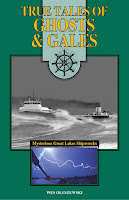
The complete story of the burning of the KATY REID can be found in my 2003 book "True Tales of Ghosts and Gales." Unfortunately, that book went out of print in 2012, but copies can be had on Amazon- many for a really good price. Click on the book cover here and take a look.


You can get my books signed and
 personalized  HERE