WHY DID LAKEBOATS HAVE PILOTHOUSES UP FRONT?


Often folks ask the question as to why the old lakeboats had their pilot houses located on the bow? I’ve seen speculation bantered about on social media.

“Fog, it had to be fog.”

“They wanted to keep the deck officers away from the engine room crew.”

Nice tries, but not even close. The actual reason for the configuration had nothing to do with those two things. In order to understand why the lakeboats evolved in this manner you must first take your perspective out of this modern age of electronic navigation, lighted aids to navigate by, Coast Guard rules of navigation, clean burning engines, radio communications and all modern considerations for safety. NONE of that existed in the era to which I’m about to transport your brain… but starting there we will see the correct answer.

The correct answer isn’t one of meteorology or sociology, but rather it is one of necessity caused by design evolution. Here’s how it goes…

In the early 1830s the steamboat concept began to catch on in the Great Lakes region. That trend was almost totally supported by the passenger trade. Keep in mind that the “frontier” of America began at Buffalo, NY in that era and the way that you went west was by water. The opening of the Erie Canal allowed folks from the east to easily travel to the shores of Lake Erie and then catch a steamer “west.” Those first steamers were built upon the common design used for any large floating vessel at the time- which was that of the sailing ship. The steam propulsion equipment was placed into a sailing type hull and away you went. In fact, all of those early steamers also carried sail rigging to augment their steam power plants, which often broke down. Likewise, the steering equipment was exactly the same as that used on sailing vessels. The rudder was controlled by a series of ropes and pulleys that went directly up to the fantail where the ships steering wheel was located. That’s why the old sailing ships had such huge steering wheels- because the wheelsman needed the leverage to move the wheel and the huge rudder. It was all done by hand. Thus, the early steamers also had a wheelsman standing on the fantail with a huge wheel.

Look at this poor wheelsman (arrow) and the crowd he has to navigate while trying to see through his own ship's  equipment.

Get your signed and personalized copy of Wes' books HERE!


That wheelsman and captain had to not only watch their compass and barometer, but they also had to watch for traffic in the crowded waterways- and in the 1830s those waterways were packed with everything small rowboats to schooners that were big enough to sink a steamer of the day in a collision. There were essentially no rules for navigation- it was the wild west of fresh water history. To make matters worse, not only did the wheelsman and captain or mate have to look through their steamer’s rigging, but their view was also obstructed by the steamer’s walking beam and smoke stakes. Additionally, there was the smoke itself that came from the wood fuel burned buy their own vessel (yes- in those days they burned wood and not coal. Wood was more easily had and cheaper.) All of that smoke seemed to always drift aft and right into the faces of the fellows who were guiding the vessel.

Pilothouse forward- problem solved


Very soon it was determined that most of those issues could easily be negated by simply placing the ship’s wheel forward and atop the passenger cabins. Also, it was far more comfortable to have that wheel housed in a small structure with windows that opened and closed. That, however, did not go over well with the old timers. Sometimes, you had the pilothouse with a wheel inside, and a second wheel on top. Now you get to ask how that came about?

The “open air” pilothouse evolved with the clear cargo deck configuration. Prior to 1869 the transportation of bulk cargoes, such as coal and iron ore, was primarily by way of that lake schooners and sailing vessels. The reason was that they were able to load and unload the product more easily and transport it more cheaply. In that era the demand for coal was beginning to climb and ore was showing hints of being eventually in greater demand. Sailing vessels had no passenger accommodations and other than their masts and their required rigging, their decks were clear and hatches easily accessed by shore side equipment, (chutes for coal loading and buckets filled by hand shovel and hoisted by horses to unload.) Steamers used side ports and had bulk materials wheeled aboard in barrels and unloaded in the same manner.
FOREST CITY- the second of the the lakeboats to have the traditional  cabin configuration- 1870. (Note: there are no photos of the HACKETT)


 In Cleveland, OH, in 1869 Eli Peck built a 211 foot vessel that was the first steamer to have the soon to be traditional lines of a Great Lakes oreboat. She was the R.J. HACKETT and what he had done was eliminate her central cabins to allow her to load and unload bulk cargoes like a schooner. This left her engine working aft along with her galley and engine crew and her pilothouse and crew cabins forward where they were located anyway. The HACKETT did so well that the following year he launched her twin the FOREST CITY. As this class of vessels began working the booming lumber trade as well as the towering ore and coal loading docks, the captains wanted better all-around visibility. Often the lumber was stacked on deck higher than the pilothouse and prevented the captain and wheelsman from seeing aft. Thus the open-air bridge was evolved where the poor wheelsman again found himself on top of the pilothouse, out in the weather where he had been 30 years earlier! The open air bridge was a common site on oreboats until the 1920s.

Today there are fewer and fewer traditional pilothouse forward lakers in service. Most are all cabins aft, or “stemwinders” as they were called way back in the lumbering days. Some of the old timers will tell you that they like not having to walk all the way back to the galley. 

But they’re also now “…stuck with all that damned noise…” as the late great Wally Watkins told me.


If you liked this information check out my books on the subject... I've written 17 on Great Lakes history.


Remember November 10th


KEYSTONE STATE lost November 10, 1861 with all 33 persons aboard. Amazing drawing done by the great Bob McGreevy I'd suggest visiting his site and buying his work!

It is a good thing every November 10th that the folks interested in the vessels that sail the Great Lakes pause to remember this loss of the EDMUND FITZGERALD. Popularized by the 1976 hit song written as an afterthought by Gordon Lightfoot (yes he needed filler for one last track on his “Summertime Dream” album and so he wrote this song), the haunting ballad drew many folks into the realm of “boat nut,” “boat watcher” and maritime historian. That included me and led to my second career as a Great Lakes shipwreck author.

I am often asked “How come you never wrote about the EDMUND FITZGERALD?” A question my publisher would like to see resolved- I assure you. The answer is, for the most part, that everyone else has already done it. Additionally, there are so many other stories to tell when it comes to shipwrecks on the Great Lakes- my time is better spent doing that job.

When you participate in the remembrance of the FITZ and her crew, you should also give long consideration to the thousands (Yes, “THOUSANDS”) of other vessels that have been lost on the Great Lakes as well as the tens of thousands of people that those boats took with them. Such as the IRONSIDES that took 28 to the bottom of Lake Michigan in 1875. That’s just one soul less than the FITZ took to the bottom. Or, perhaps the EQUINOX who took 25 people to their doom followed by her sister ship the MENDOTA that took 12. Both went down in the same storm. Or how about the ALPENA that, in 1880, sank taking an estimated 100 down with her? Those are just a very few examples of shipwrecks on the lakes.

The Alpena

If you get into the Dave Swayze database you’ll find more than 7,000 shipwrecks listed. They all had real people on them who have their own personal stories, yet have been largely forgotten. And you’d be surprised at how many of those vessels were lost on November 10th. So, when that date rolls around, I remember the FITZ and her crew of 29. I also try my best to rediscover all of those other folks who ventured out onto the Great Lakes and never returned.

Read more HERE!


Please, please, remember the FITZ which was lost on November 10th, 1975. Play the song. Meanwhile I’ll be remembering the ATLANTIC which was lost on that same date in 1903, the JAMES BARDON No.7 of that date in 1890, BARGE 104 of 1898, the BOAZ of 1887, the BRIDGET of 1835…

And that’s just workin’ my way through the “Bs” folks…

My Favorite Drawing

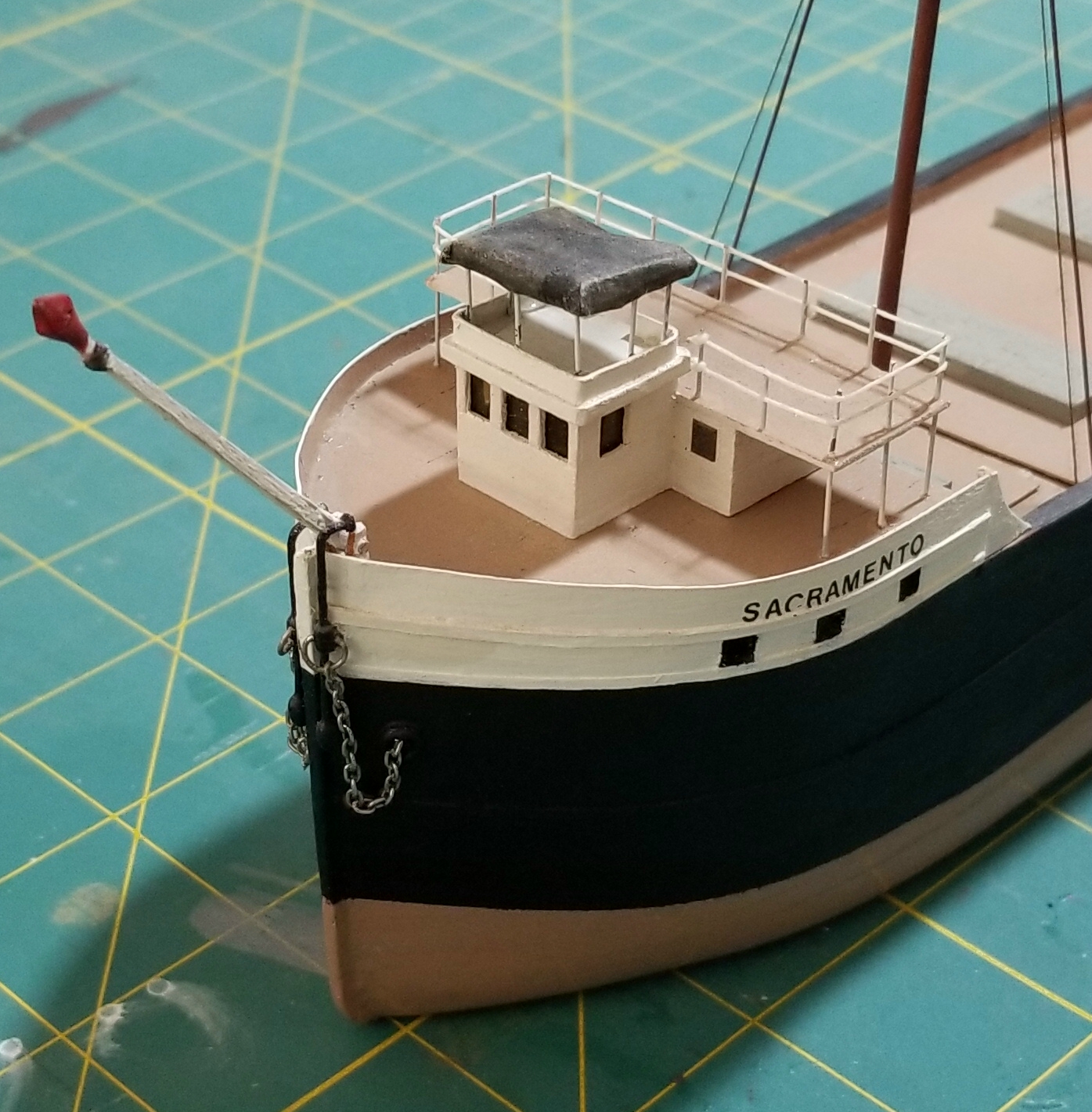
With the posting of my photo of my R/C model of the Davidson steamer SACRAMENTO the question came up as to what plans or drawings I used to make such replicas of old lakeboats. The answer was that I often draw my own plans, but sometimes I use what others have drawn- such as in the case of the SACRAMENTO. In that case I used the actual Davidson Shipyard plans from an 1898 copy of Marine Engineering... seen here.


This drawing, provided to me by my boat-chasing pal D.J. Story, is actually that of the THOMAS CRANAGE, which is of the same class as the SCRAMENTO. The CRANAGE was wrecked on Georgian Bay in 1911 and her entire saga, which corrected 80+ years of bad history by the way, is in my book "Mysteries and Histories."


Since there are almost zero documents surviving from the Davidson yard- I figured this was a great drawing to base the model upon. In fact it was so great that it is actually on my personal business card.


The drawing itself allows a close look into how these steamers were laid out.


Captain Davidson built some of the largest wooden vessels in the world and there has always been some mystery as to how they were constructed.


 A key to this secret appears to be the lattice of steel strapping and cables that criss-cross within and outside of the hull timbers. 


They provided strength and support for the wood timbers that made up the basic hull. Today this can be easily seen on the remains of the schooner barge and steamer that lay on the west bank of the Saginaw River at Bay City where the Davidson Shipyard was located. Abandon in 1929 with the onset of the Depression these wooden ships were left to rot.


Eventually they were set upon by what, in my opinion, was a serial arsonist who set fire to wooden boats left abandon along the river in the late 1940s and 1950s. Each was burned to the waterline so you have to wait for when the river water is quite low in order to see the wrecks.


Each vessel was double hulled and the sides were bolted together with the bolts also running through the straps- as seen here.

Get a signed and personalized copy of Wes' books HERE!


In case you're wondering the above photos are of the  giant schooner barge MONTEZUMA.


 The MONTEZUMA in better days.


Get an autographed and personalized copy of Wes' books HERE


Resting next to the MONTEZUMA is the steamer SHENANDOAH 


Look closely and you can see her two boilers peeking above the murky water.


Her strapping is also visible.

Okay... to give you a better feeling for what you are seeing...

When the vessel burned, the decking under her boilers burned away. That allowed the boilers to simply drop down to the position they are in now as illustrated by the drawing.


Meanwhile, her sister the SACRAMENTO was not free of arson- she too soon was set upon by the firebug. She burned in the drydock where she had been abandon in 1929.


The arsonist burned her to her bilge.


MONTEZUMA was also torched and burned to the waterline.

There was one other act of arson that, from a historian's standpoint, was even more vulgar. The story goes that after the wrecks had lingered on the riverbank for several decades the city was out to clean up the eye-sore and thus decided to have the owner of the property pay to have the problem removed. A kin of James Davidson decided to obliterate all ties and evidence that would prove that person's ownership of the property. So it was ordered that every scrap of paper, every drawing, every record was taken out into the yard, doused with kerosene and burned. No records meant no proof of ownership and the property was a ward of the city. This is why there are no records as to how exactly James Davidson built his amazing lakeboats.


Today the Davidson yard is an amazing park and river walk. When the water is very you can stand on a large deck that is constructed over the MONTEZUMA and look at the wrecks. 


If the water is really, really low- you can touch them. GRAMPIAN was mostly removed by the city. The SACRAMENTO was buried. Yet the MONTEZUMA, SHENANDOAH, MATANZAS and GRANADA remain.

The yard circa 1946

The Davidson yard today.

Get a signed and personalized copy of Wes' books HERE!


Brought my model boats out... after a decade

So... what do author's/airline transport pilots do for relaxation? Well... since 1979 I've built R/C model lakeboats. The next question is; what does that same person, only with AD/HD, do for relaxation? The answer is; a whole lotta boats!


I was once in a conversation with a psychologist who casually asked what I did to relax? I replied that I worked on my radio controlled model boats. She said, "That's nice..." and then asked how many I had? I replied, "58." There was a moment of silence and she asked, "Don't you think that's a little unusual?" 


Not for me.


The majority of my current fleet


My fleet dwindled down to 42 lakeboats by the time we bought our house by the bay in late 1999. Shortly there after we had our first child and I quickly found that finely detailed model boats and little kids do NOT go together well. By 2008 we had two kids and needed a house with more room- so we had the old place bulldozed (why give up a perfect location eh?) and a new, much bigger one built. In the process of moving out I carefully packed all of my boats into assorted boxes and handled them personally. When we moved into the new place I stored all of the boxed boats as far back in our storage wing as I could get them. I figured they'd be safe there until the kids got older... I was right. In 2018, a full decade later I transferred the production of my model rocket company to another company and thus cleared out all of the parts needed for that process. This left a lot of open space in my work area... the boats came back out! For the record, my wife LIKES the look of the boats as opposed to the clutter of model rocket parts and boxes. (Japanese people are like that... they loathe disorder)


Get Wes' books autographed and personalized HERE!


I was happy to see that time had been good to the fleet while it was in storage. Sure there were a few dings, but only two were damaged to a great extent. The bow rigging of the WILLIAM CLAY FORD had been smashed, as had the stern quarter of the SACRAMENTO. The SACRAMENTO was the worst off and required some major surgery. Additionally her pilothouse canopy had been smashed and 2 of her 3 spars had their peak snapped off.


Her bow canopy now fully restored


Today, she's looking good again and ready to sail again some day... more likely to gather dust on the shelf, but at least I feel better. 


Note the dime in the photo for scale.


What's interesting about my model of the SACRAMENTO is that her two lifeboats are carved from wood from the actual vessel! 


YES... several years ago, Great Lakes historian Don Comtois showed me that he had in storage some knees from the old boat that he had rescued before the city of Bay City bulldozed and buried the remains of the historic vessel in the mid 1970s. 


Remains of the SACRAMENTO before she was bulldozed by the city. Yeah, in the mid 1970s the city politicians were really big on preserving their maritime history... not.


He gave me a whole knee and from it I had several pens made (one of which I gave to Don, of course). Yet the wood was, after all of those years of exposure, so fragile that it was more difficult to mill than balsa wood. From the remaining chunks I carved the lifeboats if the R/C model of the SACRAMENTO.


Thus... the original steamer lives on.


Now- it is on to repairing and finishing the rest of the fleet... as well as writing my next book of course.

Get Wes's Books HERE


Book 18 is here!


Get an autographed and personalized copy HERE!

Book 18 from Avery is on Amazon


My 18th Great Lakes book (24th book overall) is now here for sale!

THE WHAT IT'S LIKE TO BE AN AUTHOR DEPARTMENT

Common reader's question: "You wrote this?" (flips open the book) "Okay... what's the first sentence in the second chapter?"

My answer: "I don't freakin' remember."


Here's the deal- I don't write that way and my cheeseball brain doesn't function like that. Yet, some people think that's a good test of if or not you actually composed the text.

The reality is that when I start a story, I actually move into it. I try and put myself back in that place and time and look around. With the help of some modern resources I take myself back that that specific time and date and see what life was like. Then, once I get orientated, I add in all of the tastes and smells and sensations that the people would have experienced- apply them to the facts and write the story. If I feel like I'm "there" then my readers will feel like they are there as well.

Then I leave it and move onto the next story. The story previous is thus zipped into my brain's cluttered memory bank and eventually over-written by new data. Occasionally I'll open up one of my previous books and upon reading a paragraph or two I say to myself, "Did I write that? Dang... that's pretty good." Frankly I don't remember writing it. Additionally, on a few occasions I'll come across a good prospect event for a shipwreck story, but think that it sounds a bit too familiar. After a check I find that, nope- I already wrote it.

Thus you have my world as a writer. It is not neat rows of files in alpha-numeric order, but rather it is a full-blown mess of strewn-about papers, ideas, drawings, maps and stuff I wanna write about... if I haven't already. If you get one of my books and wanna quiz me on it, well... I don't take quizzes... ever. On the other hand if you wanna take a story and wade through the reference material and thought processes needed to construct it- I'll be happy to join you in the process. Hope yer' not busy for about a month.

A random book signing at Whitefish Point

Overall, I love my readers- even the ones who try and quiz me. Although everyone should keep in mind that my most recent book 18 months to hit the stores after I finished it- so I'm working years ahead of what you are holding in your hand when you try and quiz me.

What's the first line in the second chapter?

Damned if I remember- I'm working in 1882 right now.

Get your autographed and personalized book from Wes HERE!


My 17th Shipwreck Book!


My 17th Great Lakes title is in from the printer!


Avery now has my latest book on their web site! Order yours today!

Also check out this book of mine...